
Client
Niitive - based in Singapore
Sector
IT/Edtech
My Role
Product Designer/Entrepreneur
Project Time
Mar 2024 - Sept 2024
-
The phase 1 of the project took place between March 2024 and August 2024
-
Niitive, based in Singapore, engaged DezignGeeks, the company I founded, to help realize their vision.
-
As the founder, I oversaw all aspects of the project, from client acquisition and sustenance to design and development.
-
However, my primary focus was on the comprehensive product design for Niitive.
The Problem
-
Over 74% of the world’s population does not use English in their daily lives
-
The consumption of digital video content through platforms like YouTube and social media has surged in the post-COVID era
-
However, most rich, relevant, and specific content across various domains is predominantly available in English, leaving the remaining 74% of the global population at a disadvantage
Digging deep in Research
-
The client's vision was commendable, but I needed to delve deeper to determine its feasibility.
-
I began with market research, studying competitors and user behaviours
-
Additionally, I thoroughly investigated AI translation services—including speech-to-text, transcription, and text-to-speech solutions from Google, Azure, and other OpenAI platforms—to assess their viability for the project.
User Research
-
The first thing I did is to reach out to set of Non-English speaking users(non-proficient English speakers) and tried understanding their content consumption habits.
-
I conducted set of Attitudinal Research involving interviews and surveys.
-
To have a behavioural analysis,I also arranged for a field study to note user behaviour while consuming contents
Research Insights
95% of users prefer to watch content in-app rather than download it for later.
Additionally, 50% of users are unaware of the higher quality content available in English on platforms like YouTube and Instagram.
On YouTube, users often rely on subtitles to understand foreign content, but they find it challenging to consume and question the accuracy of these translations.
Consequently, many students miss out on valuable educational content and teachings that are available exclusively in English
Some Qualitative Questions Asked
Can you describe your experience when trying to watch content in English on platforms like YouTube or Instagram? What challenges do you face?
How do you usually handle content in a foreign language that you are interested in? Do you rely on subtitles, and if so, how do you find their quality?
Have you ever missed out on any educational content because it was only available in English? Can you share specific instances or subjects where this happened?
How do you feel about downloading or saving videos to watch later versus watching them directly in-app? What influences your preference?
Can you describe any specific content areas (e.g., education, entertainment, tutorials) where language barriers have been a problem for you? How do you usually cope with this?
How important is it for you to have content available in your native language versus English? Why do you prefer one over the other?
Research Snapshot


Personas


Competitive Analysis
-
Purpose: To identify strength and weakness in competing apps
-
Goals:Come up with features for Niitive app based on analyzing competitors’ weaknesses and strengths
Competitors

Web-based

Mobile app
Feature
Rask AI
Captions
Raw File translation
Youtube Video
Translation Accuracy
90%
82%
In App Viewing
Offline Viewing
Voice Cloning
Transcript Editing
Translation Accuracy
UX Evaluation
Criteria
Rask AI
Captions
Ease Of Use
3/5
4/5
Onboarding Experience
Smooth
Confusing
Navigation and Flow
Intuitive
Streamlined
Visual Design
Outdated
Modern
Accessibility
Good
Poor
Consistency
High
High
Error Handling
Clear
Clear
Youtube Video
User Reviews

Overall Assessments and Insights
Rask AI - Strengths
-
Social Media Support
-
Accurate Translations
-
Edit transcriptions
-
Voice Cloning
-
Lip Sync
Rask AI - Weakness
-
Web based
-
Target Users are mostly content creators
-
No Offline Support
Captions - Strength
-
Accurate translations
-
Voice Cloning
-
Lip Sync
-
Mobile App
Captions - Weakness
-
Target Users are mostly content creators
-
No social Media Support
Takeaways and Feature Proposals
There is no standard video translation mobile app available, except for Captions. The accuracy of existing web-based translation applications is often questionable. Additionally, the Captions app does not support direct translation of content from YouTube or Instagram. Most of these apps are geared towards content creators, focusing on editing features rather than serving the needs of the average user.
Based on competitive analysis, user journey mapping, research insights, and discussions with various stakeholders, including the client, I proposed the following features. Due to their complexity and the effort required for implementation, these features were divided into two phases.
-
Onboarding/Login
-
In-App Video Tutorial
-
Raw video translations
-
Youtube Video Translations
-
Sample Videos
-
Download Translated Videos
-
Lip Sync
-
Voice Cloning
-
Free and Subscription model
Stakeholder differences in decisions and strategy to resolve
-
Product Owner wanted: Only a paid subscription model to ensure early revenue
UX Research showed: Users prefer trying the product before paying
Solution: Introduced a freemium model with limited free translations and upgrade prompts -
Engineering team wanted: Early implementation of lip sync and voice cloning as core differentiators
UX Insight: These features were not top priorities for early adopters and added tech complexity
Solution: Deferred to Phase 2 roadmap, focusing MVP on core translation functionality -
Marketing team wanted: Highlight YouTube translation to drive engagement and virality
Legal/compliance concern: Potential issues around copyright and content policy
Solution: Added clear disclaimers, implemented translation for public videos only, and built a moderation layer -
Design team proposal: Sample videos and in-app tutorials to reduce cognitive load for first-time users
Stakeholder concern: May delay MVP launch
Solution: Created quick-start onboarding with optional tutorials to balance guidance with speed

Information Architecture
Once the features were discussed,I moved to ideation which mostly involved several brainstorming,mind mapping and several iterations of the Information Architecture.Here is a partial glimpse of the same as the IA is huge.
Paper Wireframes
-
To save time and reduce complexity, I quickly created a set of rough yet presentable wireframes for brainstorming and discussion with various stakeholders.These wireframes underwent several iterations
-
I also conducted a basic usability tests on the paper prototypes to refine the app's flow and structure.
-
This approach allowed for low-level adjustments before committing to detailed, time-consuming high-fidelity wireframes.

Visual Design


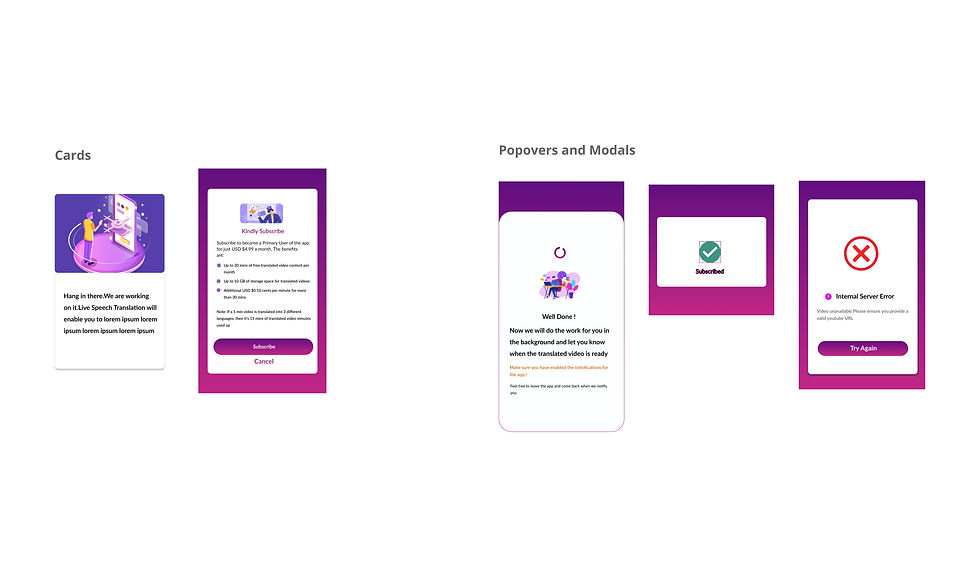

Result and Success Stories


Impacts and Measures
To evaluate the success of Niitive’s UX design and product decisions, we tracked key performance indicators (KPIs) post-launch:
-
User Adoption
-
12K+ installs within the first 3 months across India, SEA, and Africa
-
40% returning users within 7 days (vs. industry avg. of 20–25%)
-
Feature Engagement
-
65% of active users used the YouTube Translation feature weekly
-
38% tried both Youtube And Raw File translations within 2 months
-
Conversion
-
22% conversion from free to paid users within 6 weeks of onboarding
-
Subscription revenue grew by 3.4x within the first quarter
-
User Satisfaction
-
4.8★ average rating on Google Play
-
90% of surveyed users rated the experience as “intuitive” or “very intuitive”